
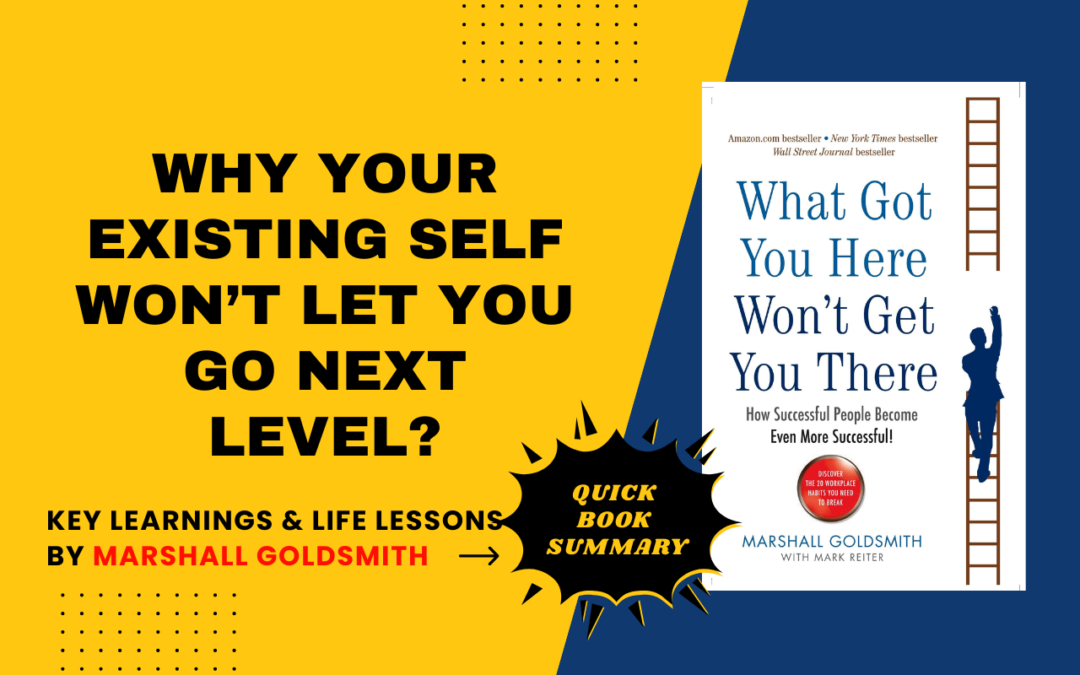
What if the very habits that earned you promotions, praise, and power are now the invisible walls keeping you from your next breakthrough?
You’re not failing because you’ve lost your edge. You’re stuck because your strengths have fossilized into behavioral reflexes—so automatic, so rewarded, you no longer see how they repel the very people you need to lead.
In What Got You Here Won’t Get You There, Marshall Goldsmith doesn’t coach you to do more. He invites you to unlearn. To confront the subtle, self-defeating patterns that high achievers mistake for virtues: the need to win every point, the silence where praise should be, the reflex to “improve” every idea—even when it kills ownership.
This isn’t a book about fixing incompetence. It’s a mirror held up to the tragedy of the competent—and a roadmap to evolve beyond the self that got you here.
In this summary, you’ll go beyond tactics into philosophy, psychology, and ethical leadership, with fresh real-world examples and actionable wisdom. You’ll walk away not just with insights—but with a new way of being in your success.
What got you here won’t get you there : About the Book and the Author
Marshall Goldsmith is widely regarded as America’s preeminent executive coach, having guided CEOs at Ford, Pfizer, and the World Bank. In 2007, after decades of observing how brilliant leaders self-sabotage, he published What Got You Here Won’t Get You There—a radical departure from typical leadership advice. Instead of teaching people to climb faster, he asked: “Are you climbing the right mountain—and are you pushing others off as you go?”
The book emerged during the rise of emotional intelligence in leadership, but Goldsmith went further: he exposed how success itself distorts perception. Today, in an era of hybrid teams, flattened hierarchies, and trust deficits, his message is more urgent than ever. Technical mastery opens doors—but relational maturity determines how long you stay in the room.
What got you here won’t get you there : The Core Idea of the Book
Goldsmith’s central thesis is deceptively simple yet existentially profound: past success creates behavioral inertia. The habits that earned you recognition—decisiveness, competitiveness, intellectual dominance—become unconscious reflexes. Once you’re in a position of influence, these same traits manifest as interpersonal liabilities: interrupting, correcting, needing to win, or failing to acknowledge others.
But this isn’t just about “soft skills.” It’s about ontological shifts—the need to evolve from a performer (valued for output) to a multiplier (valued for enabling others). The book argues that leadership at scale is not about being right—it’s about making others feel capable, heard, and valued. And that requires unlearning the very behaviors that made you feel worthy in the first place.
Key Insights and Lessons from What got you here Won’t get you there
1. Winning Too Much: The Zero-Sum Trap of the Achiever
Goldsmith identifies “winning too much” as the #1 career-limiting habit. It’s not about big battles—it’s the compulsion to prevail in trivial disagreements, debates, or decisions, simply because you can.
This reflects a Cartesian illusion of the self as separate and superior—a mindset that treats every interaction as a contest rather than a co-creation. But human systems thrive on reciprocity, not domination.
A venture capitalist, known for sharp insights, insists on rebranding a founder’s startup name during a casual lunch—“just to test positioning.” The founder smiles politely but later declines his follow-on investment. Why? Because he sensed the VC saw him as a project to optimize, not a partner to empower.
So what to learn here: Before speaking, ask: “Does winning this matter more than preserving trust?”Sometimes, losing gracefully is the highest form of influence.
2. Withholding Praise: The Arrogance of Assumed Recognition
High performers often believe, “If I haven’t fired you, you must be doing fine.” But silence reads as indifference—or worse, contempt.
In phenomenology, to be seen is to exist in the social world. Withholding praise is a form of relational erasure—denying another’s effort the dignity of acknowledgment.
Lets understand with an example:
A senior engineer never compliments her junior team. She assumes competence is its own reward. But during a critical product launch, two juniors quietly accept offers elsewhere. In exit interviews, both say: “I never knew if my work mattered to her. It felt like I was coding for a ghost.”
Practical Takeaway: Give specific, timely praise at least once a day. Not “good job”—but “Your refactor reduced load time by 40%. That was brilliant.” Make visibility a ritual.
3. Adding Too Much Value: The Ego’s Silent Sabotage
You hear a good idea—and can’t resist “improving” it. Goldsmith warns: this often destroys the idea’s owner, even as it “enhances” the idea.
This is epistemic colonization—imposing your cognitive framework onto another’s creation, erasing their authorship in the name of “help.” True collaboration requires intellectual humility: the ability to amplify without appropriating.
A city planner presents a community garden proposal to her department head. He responds: “Love it! Now let’s add solar panels, Wi-Fi, and a café.” Her face falls. Her vision was about neighborhood healing, not gentrification. His “value-add” revealed he never truly listened.
Practical Takeaway: Practice “Yes, and…” without “but.” Say: “That’s powerful. Tell me more about how you’d implement it.” Let others own their genius.
4. Refusing to Apologize: The Myth of Invulnerability
Many leaders equate apology with weakness. Goldsmith flips it: apology is the fastest path to relational repair.
Drawing from Emmanuel Levinas, the self is constituted through responsibility to the Other. To say “I’m sorry” is not self-abasement—it’s ethical maturity: acknowledging your impact, regardless of intent.
A school principal cancels a teacher’s professional development without explanation. The teacher feels disrespected but says nothing. Months later, when the principal launches a new literacy initiative, the teacher—once a champion—stays silent. Had he simply said, “I owe you an apology—that was poorly handled,” he might have kept his strongest ally.
Practical Takeaway: Apologize quickly, specifically, and without justification: “I’m sorry I interrupted you in the meeting. That wasn’t respectful.” No “but.” No “if.” Just repair.
Memorable Quotes or Standout Ideas
“We don’t believe we need to change because we don’t see how we’re perceived.”
→ Self-awareness isn’t introspection—it’s external feedback made internal.
“Beware the curse of ‘adding too much value.’”
→ Sometimes, the greatest gift is to let someone’s idea stand—untouched, unimproved, wholly theirs.
“Don’t tell me what I did wrong. Tell me how I can do better tomorrow.”
→ This is feedforward: future-focused, solution-oriented, free of blame.
“The higher you go, the more your problems are behavioral.”
→ Technical excellence gets you to the table. Relational wisdom keeps you leading it.
How to Apply This Book in Your Life
Build This Habit: The Daily Relational Audit
Each evening, ask:
- “Did I make someone feel seen today?”
- “Did I win something I didn’t need to?”
- “Whose idea did I amplify without altering?”
Track for 14 days. Patterns will emerge.
Change This Mindset: From “I Must Be Right” to “I Must Be Relational”
Replace the need for correctness with curiosity. When challenged, say: “Help me understand your view.”
Try This Daily Action: One Unprompted Acknowledgment
Text, email, or tell someone—“What you did today mattered. Here’s why…” Be specific. No agenda.
Practice Feedforward:
Instead of asking for feedback, ask: “What’s one thing I could do differently tomorrow that would make working with me easier?” Focus on the future, not the past.
Who Should Read This Book
This book is essential for high-performing leaders hitting an invisible ceiling, technical experts promoted into people roles, or anyone told they’re “brilliant but difficult.” It’s especially vital for executives, founders, academics, or creatives whose success has insulated them from honest feedback—and whose influence now depends not on what they know, but on how they make others feel.
Key Takeaways (Short Recap)
- Success creates behavioral inertia—your strengths become blind spots.
- Winning trivial battles costs you strategic trust.
- Praise is ethical witnessing—not flattery.
- True collaboration means amplifying without appropriating.
- Apology is not weakness—it’s the fastest path to relational repair.
Final Thoughts
Goldsmith’s work haunted me long after I finished the book—not because it exposed my flaws, but because it revealed a deeper truth: growth at the top isn’t about acquiring more. It’s about shedding the self that no longer serves the whole.
In a world obsessed with personal branding and relentless optimization, this book is a quiet rebellion. It asks us to trade the armor of achievement for the vulnerability of connection. And in doing so, it offers something rare: a path to leadership that doesn’t cost your humanity. If this summary stirred something in you, read the full book—not as a manual, but as a mirror.
Then ask one person you trust: “What’s the one thing I do that gets in my own way?”
The answer might be the key to everything that comes next.