
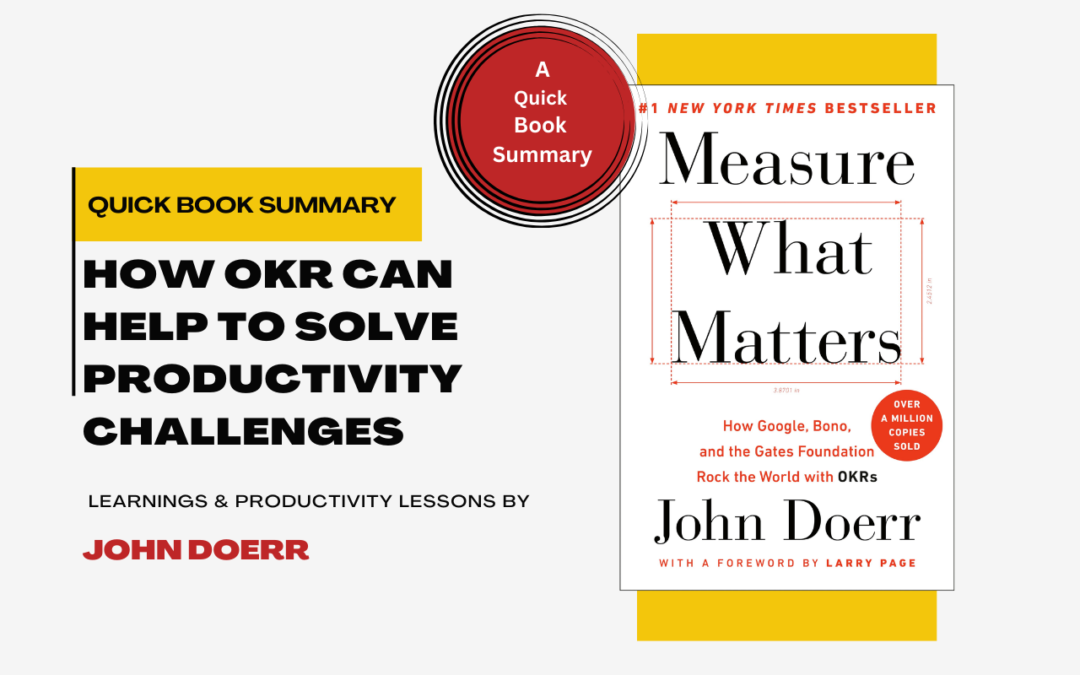
Most people don’t lack goals. They lack clarity. Teams stay busy, calendars remain full, and reports keep flowing—yet progress often feels slow, uneven, or unclear. Measure What Matters by John Doerr was written to address this exact problem. The book does not promise motivation or quick wins. Instead, it offers a structured way to decide what deserves attention, how success should be judged, and how teams can stay aligned while moving fast.
This pillar summary breaks down the book in full working depth. It explains the thinking behind OKRs, how they behave in real organisations, why they often fail, and how to use them as a long-term execution system rather than a short-term planning exercise.
About the book and the author
- Book title: Measure What Matters
- Author: John Doerr
- First published: 2018
- Category: Business execution, leadership, goal management
John Doerr is a venture capitalist known for his early involvement with companies such as Google, Intel, Amazon, and LinkedIn. He introduced the OKR framework to Google in its early days and later refined the approach through decades of observing how teams grow, break, and recover.
The book combines operating experience, real company stories, and a structured framework meant to scale across teams, industries, and stages of growth.
The core problem the book is solving
Most organisations confuse activity with progress.
People work long hours, complete tasks, and attend meetings, yet struggle to answer a simple question: Are we getting closer to what we want to achieve? Goals exist, but they are often vague. Metrics exist, but they are not connected to direction. Reviews happen, but learning arrives too late.
Measure What Matters argues that success improves only when three things come together:
- Clear direction
- Visible outcomes
- Regular reflection
OKRs exist to connect these three elements into a repeatable system.
What OKRs actually mean in practice
OKRs stand for Objectives and Key Results, but the book treats them less as a formula and more as a way of thinking about work.
Objectives define direction
An objective answers the question: What matters most right now?
A strong objective:
- Describes a meaningful change, not routine work
- Is easy to understand and remember
- Feels motivating without being vague
Objectives are not meant to describe tasks or daily responsibilities. If an objective can be achieved simply by “doing your job,” it is probably not an objective—it is maintenance.
Good objectives point toward improvement, growth, or change.
Key results prove progress
Key results answer a different question: How will we know if the objective is working?
They:
- Are measurable and time-bound
- Describe outcomes, not actions
- Can clearly succeed or fail
For example:
- “Launch a new onboarding flow” is an action
- “Increase new user activation from 35% to 55%” is a result
This distinction is where most teams struggle. When key results turn into task lists, OKRs lose their value.
Why traditional goal-setting fails
The book highlights several reasons why older goal systems stop working as organisations grow:
- Goals are set annually but reviewed rarely
- Success is judged subjectively
- Teams optimise locally instead of collectively
- Performance discussions focus on effort rather than impact
As a result, teams become busy but disconnected. OKRs fix this by shortening the distance between intention and evidence.
Focus is not optional—it is designed
One of the strongest ideas in Measure What Matters is that focus does not happen naturally. It must be designed and protected.
High-performing teams do not chase everything that sounds important. They:
- Limit the number of active objectives
- Drop good ideas to protect the best ones
- Accept trade-offs openly
The book shows that restraint is not weakness. It is what allows real progress to happen without dilution.
Transparency as an execution tool
Doerr strongly supports making OKRs visible across the organisation. This is not about control or monitoring—it is about alignment.
When goals are open:
- Teams understand how their work connects to others
- Conflicts appear early instead of late
- Collaboration improves without extra meetings
Transparency reduces internal friction because priorities are no longer hidden or assumed.
Stretch goals and ambitious thinking
The book separates goals into two types:
- Committed OKRs, which must be achieved
- Stretch OKRs, which push teams beyond comfort
Stretch goals are designed to encourage better thinking, not guaranteed success. Achieving 60–70% of an ambitious goal can still represent strong progress.
However, the book clearly warns against linking stretch OKRs directly to compensation. When rewards are tied too closely to targets, ambition disappears and teams start playing safe.
CFRs: the system that keeps OKRs alive
Many readers focus only on OKRs and overlook CFRs, which stand for Conversations, Feedback, and Recognition. The book treats CFRs as the human layer that keeps execution healthy.
Conversations
Regular check-ins replace annual reviews. These discussions focus on progress, obstacles, and learning rather than judgment.
Feedback
Feedback happens in real time, allowing teams to adjust while work is still in motion.
Recognition
Recognition is separated from scoring. People are acknowledged for contribution, learning, and effort—not just numbers.
Together, CFRs turn OKRs into a living system instead of a quarterly document.
How OKRs are reviewed in real life
The book promotes frequent, lightweight reviews rather than heavy formal meetings.
A good review:
- Focuses on outcomes, not explanations
- Surfaces blockers early
- Encourages honesty without fear
Weekly check-ins keep goals relevant and prevent surprises at the end of a quarter.
Common failure patterns explained in the book
Doerr openly discusses why OKRs often fail in practice:
- Too many objectives dilute attention
- Key results written as tasks hide outcomes
- Leadership does not model the system
- OKRs are treated as reporting tools
- Reviews turn into blame sessions
In every case, the issue is not the framework itself but how it is used.
Applying OKRs at different levels
For individuals
OKRs work well for personal and professional growth when kept simple:
- One meaningful objective per quarter
- Two or three measurable key results
- Weekly self-review of progress
This helps individuals shift focus from busyness to direction.
For teams
Team OKRs should align with company priorities without copying them blindly.
- Teams should decide how they contribute
- Conflicts should be discussed openly
- Progress should be reviewed together
Shared goals improve accountability and trust.
For leadership
Leadership behaviour determines whether OKRs succeed.
- Leaders must use OKRs publicly
- Priorities must be protected actively
- Learning should be rewarded, not hidden
When leaders treat OKRs seriously, teams follow.
OKRs and culture
One of the book’s deeper messages is that systems shape behaviour. When outcomes matter more than activity, people think differently about work.
Over time, OKRs can:
- Reduce unnecessary meetings
- Improve decision-making speed
- Encourage ownership and initiative
But this only happens when the system is applied consistently.
Where OKRs create the most impact
The book highlights several areas where OKRs work particularly well:
- Product development, where learning speed matters
- Sales and growth teams, where outcomes are measurable
- Operations, where efficiency and reliability are critical
- Leadership, where alignment shapes everything below
OKRs adapt well when language and metrics reflect the team’s reality.
Who should adopt this framework
OKRs are especially useful for:
- Growing teams facing alignment issues
- Leaders struggling to connect effort with results
- Organisations moving beyond intuition
- Professionals seeking clarity in complex roles
Who should be cautious
The book also implies that OKRs are not always the right tool:
- Teams without basic trust
- Organisations unwilling to review honestly
- Leaders looking for control rather than clarity
Without discipline, OKRs become another layer of noise.
The deeper lesson of Measure What Matters
Beyond frameworks and examples, the book teaches a quiet but powerful idea: what you choose to measure shapes how people behave.
When goals are clear, outcomes are visible, and reflection is regular, progress becomes intentional rather than accidental. OKRs work not because they are complex, but because they force honesty—about priorities, trade-offs, and results.
Final thoughts
Measure What Matters is not about working harder or setting better intentions. It is about building a system where direction is clear, progress is visible, and learning happens continuously.
For teams and individuals tired of busy work with unclear impact, the book offers a structure that scales with complexity instead of collapsing under it. Applied with discipline, its ideas can change how work feels—and how results show up.
Frequently asked questions
Is this book useful outside tech companies?
Yes. The framework works across industries when goals and metrics reflect real outcomes.
Can OKRs replace traditional performance reviews?
They replace annual judgment-heavy reviews with ongoing progress conversations.
How long does it take to see results from OKRs?
Most teams notice clarity and alignment within one or two cycles when reviews are done honestly.
Are OKRs suitable for small teams?
They work especially well in small teams where feedback loops are fast.